 NearEats
Moving to a new city: finding your regular spots in the first month
The first month in a new city is when you eat well by accident and badly by default. Here is how to turn that into a short list of places you will actually keep going back to.
You have been in the city for three weeks. You are eating fine — mostly. You know the one good place on your street, the one place near the office that is worth the queue, and the one bakery where the bread is right. But "one good place" is not a set. It is a single point of failure: when it is full, when the kitchen is slow, when it closes early for no announced reason, you are back to the default of ordering in.
Finding your regulars is not about eating well for a week. It is about building a short, reliable list of places you will return to for years — the kind of list that makes you look like a local by month two. This is the method that gets there in the first four or five weeks, without turning your evenings into a research project.
Scope the search to a 20-minute ring, not an app radius
A map app's default radius is about a 3 km circle. A walking radius is about 20 minutes, which is roughly 1.5 km. That difference matters: the places inside a 3 km circle that you could reach by car are the ones you will never actually use, because you will not drive 20 minutes for dinner twice a week. The places inside the 20-minute ring are the ones that will become regulars, because they are the ones you will actually walk to on a Tuesday when you are tired.
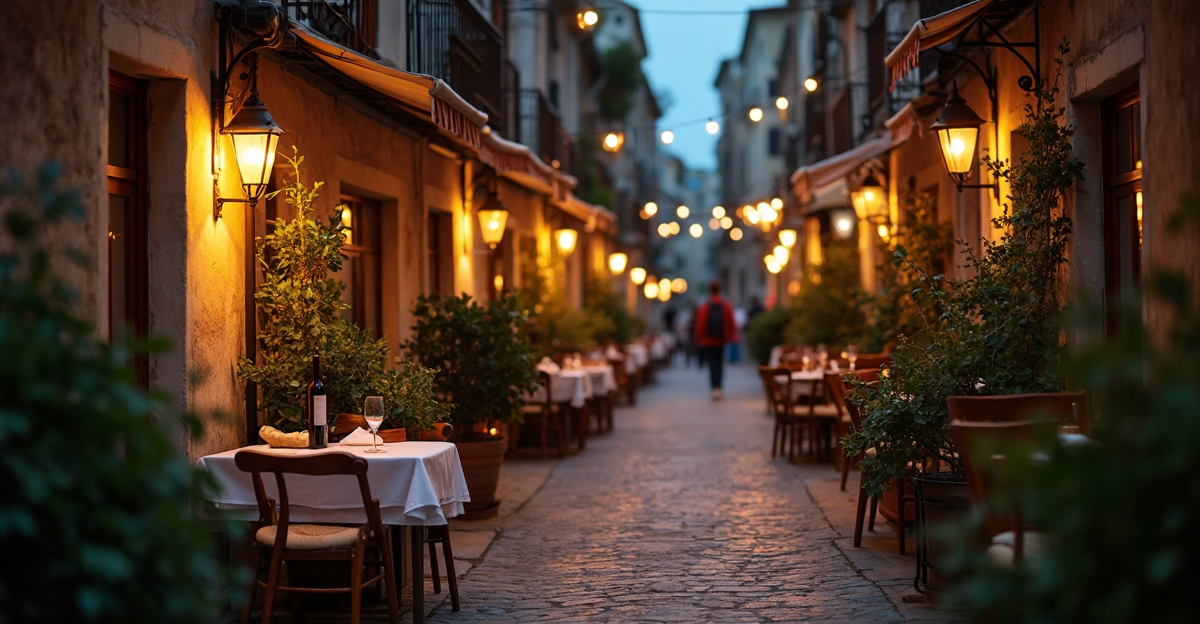
Start by walking one full loop of your 20-minute ring on a Saturday afternoon, with the phone down. You are looking for the places with tables outside, the ones with a hand-written menu board, the ones where the same three people keep coming in. You are not trying to find the best food in the city. You are trying to find the places that look like they will still be there in a year. The phone comes back out after the walk, for the shortlist — not during it.
The places that become regulars are the ones that look like they have been there for a decade, not the ones that just opened with a launch event. This is not a rule about quality — the new place can be better — but about continuity. A regular is a place you will want to go back to in six months, and a place that opened last month has not proven it will be there in six months.
Which venue types become regulars, and which do not
Not every venue type is built to be a regular. Some are structurally one-visit places: the new restaurant with the long waitlist, the fine-dining spot with a two-course tasting menu, the place that is only open on weekends. These are worth knowing exist, but they are not the kind of place you will want to go to on a random Wednesday when you need dinner in 30 minutes.
The venue types that become regulars share a few structural features:
- A fixed menu, or a small rotating menu. The kitchen can be consistent. You know what you are getting back.
- A kitchen that closes before the doors. A place where the kitchen stops at 21:30 and the doors stay open until 23:00 is a different animal from one that serves until 23:00. The first one means you are timing your dinner; the second one means you can show up at 21:45 and still get a real meal.
- A place that can seat you without a reservation. If you have to book three days ahead, it is not a regular. It is an event.
- A coffee counter or a pastry case. The place that makes a good coffee and a good cake at 08:00 is the place that will be your Saturday morning spot, even if the dinner menu is fine rather than great.
- A bar that has a kitchen, not a kitchen that has a bar. The distinction matters: a bar with a kitchen will still be cooking at 22:00 on a Tuesday; a restaurant with a bar section will have stopped at 21:30.
The reverse is also true: places that are structurally one-visit places — tourist-trap rings around stations and cathedrals, the restaurant attached to a hotel, the food-hall stalls with rotating tenancy — are not bad places, but they are not your regulars. They are your "when I have a visitor" places.
How to vet a candidate in one visit
You have walked the ring and you have a shortlist of maybe eight places. Now you need to find out which two or three of those will actually become regulars, and the only way to find out is to go to each of them once, on a normal evening, and watch.
The vetting visit is not about the food, at least not the first time. The food will tell you whether the place is good. The visit tells you whether the place works as a regular, which is a different question. Here is what to watch:
- How long does it take to get seated? If you walk in at 19:30 and are seated by 19:35 without a reservation, that is a good sign. If you are told to wait 40 minutes, that is a different question about your Tuesday evenings.
- **How is the kitchen when you ask for the second or third option on the menu?** The chef special is the best dish on the menu. The second and third options are the dishes you will actually order on a regular basis, and they are where a kitchen shows whether it can be consistent. If the second option arrives well before the chef special, the kitchen has depth.
- What is the price of a normal dinner, not the special? Look at the menu and find the price of a standard protein with a side, not the tasting menu. That is the price you will be paying every week, and it needs to be a number you are happy with when you multiply it by four.
- Is there a queue, and what is the queue like? A queue that moves is a queue. A queue that has been standing for 20 minutes when you arrive is a different signal about how the place handles a busy Tuesday.
- Does the place have a coffee menu or a pastry case? This is the Saturday-morning test. A place that does a good pastry at 08:00 on a Sunday is a place you will actually use more than a place that is only good at 19:30.
The second or third option on the menu is the honest test of a kitchen. The chef special is the one dish they have rehearsed; the rest of the menu is what you will be eating for years.
The things to settle before you call a place yours
You have been to four of the eight places. Two of them are clearly the ones. Before you commit to them as regulars, settle three things:
- Opening hours, and what they mean. A place that says 18:00–23:00 may mean the kitchen closes at 21:30 while the bar takes orders until 22:45. Ask the counter, not the menu. And a place closed on Tuesdays may still be cooking for a bar crowd that evening. The same logic — kitchen close versus door close, split hours, what the posted hours actually mean — is the first problem of eating late in a city you do not know, and it transfers directly to the regulars you are building now.
- The price of a normal dinner, including service. In some cities a 15% service charge is automatic; in others it is not. A menu price of 18 euros and a total of 21 are two different numbers, and the second one is the one you will be multiplying by four, by five, by six.
- Reservations, and whether you need them. A place that does not take reservations is a different kind of regular from one that does. The first one means you will walk in and hope; the second one means you will have a standing Thursday. Both are workable, but they are different habits, and you want to know which one you are signing up for.
These three are the things that change from place to place and country to country. The service charge, the meaning of the closing time, the reservation culture — none of them are universal, and the place will tell you all three of them if you ask.
A two-line message to a restaurant — "what time does the kitchen close on a Tuesday, and is the service charge included?" — is the cheapest information in the whole process. It costs nothing, takes thirty seconds, and it is the difference between a regular that works and a regular that frustrates you every week.
The first-month checklist
Four to five weeks is enough. Here is the sequence that gets there:
- Week one: walk the ring. One Saturday afternoon, no phone, 20-minute loop. Note the places with outside tables, hand-written boards, and the same faces coming in. You are building a shortlist of maybe eight.
- Week two: try the shortlist. One visit each, on a normal evening, at normal dinner time. Use the vetting questions: seating time, the second option on the menu, the price of a normal dinner, the queue. You are narrowing eight to four.
- Week three: settle the three things. For the four survivors, ask about opening hours, the service charge, and reservations. You are narrowing four to two or three.
- Week four: return. Go back to the two or three, on a different day of the week, at a different time. The place that works on a Tuesday at 19:00 and a Saturday at 13:00 is the regular. The one that only works on a Saturday lunch is a one-visit place with good lighting.
By the end of the fifth week you have a short list, you know what they cost, you know when the kitchen actually stops, and you have been to each of them twice. That is a set. The rest of the month is the quiet work of going back, ordering the second option, and letting the place become familiar.
A map app or an app like NearEats is the right tool for the pre-walk check here: whether a place is open now, whether it is wheelchair accessible, whether the price range fits — the facts that decide whether you walk over before you walk over. Walking the ring is the discovery engine; the app is the check before the walk. Neither replaces the other. That said, crowd-sourced map data is thin in a neighbourhood that has just been getting busy — new places appear without hours, old places disappear without notice — so treat the app as a starting point, not a source of truth, and confirm anything that matters (the kitchen close, the service charge) with the place itself.
The short version
- Scope to a 20-minute walking ring, not a 3 km app radius.
- Walk the ring once with no phone. Look for continuity, not novelty.
- Vetting visit: seating time, the second option on the menu, the price of a normal dinner, the queue.
- Settle opening hours, service charge, and reservations before you commit.
- Return to the survivors on a different day, at a different time.
- Five weeks is enough. Depth beats breadth.
Common questions
How many restaurants do I need to have tried before I have regulars?
Fewer than you think. A working set is around five to eight places: two or three for weeknight dinners, one or two for weekends, one coffee spot, and one or two for the things you specifically want — a good pastry, a late kitchen, a place with a proper veg option. Depth beats breadth: ten places you have tried once is not a set, but three you have returned to are.
Should I use a map app to find regulars, or just walk around?
Both, in sequence. Walking is the discovery engine — the app cannot tell you which of the ten places on the street is the one you will like. Apps and maps are the pre-walk check: open hours, price range, whether the kitchen is still going when you plan to go. Do the walking first, the checking second, and the walking again once you have a shortlist.
Is it worth finding a place near the office or near home first?
Near home, if you have to pick. A five-minute walk after work is a habit; a twenty-minute commute from the office is a decision you have to make every evening, and habits win on consistency. That said, a good office-side place for the one-or-two-a-month occasions is worth finding — but check the kitchen close first: many office districts empty out after 18:00 on weekdays, and the places that look busy at lunch are often the ones that stop serving early.
Drafted with AI, then reviewed and edited by Robert Jensen before publishing.
Know where to eat before you start walking
NearEats shows the restaurants, cafes and bars around you — with what's open right now, diet options, step-free access and real walking time. One-time $1.99, no subscription.

Keep reading
Eating gluten-free abroad: what to check before you sit down
Gluten-free travel fails less often than you'd expect. The places that fail you are usually predictable — here is how to spot them before the food arrives.
How to find a place open late in a city you don't know
It is 22:30, the flight was long, and every restaurant within walking distance is closing at 22:00. Here is how to find a place that will still be open.