 NearEats
Wheelchair access in restaurants: the questions that settle the visit
A restaurant can be open, welcoming and fully booked — and still be the wrong table for a wheelchair user, for one reason you can check before you leave. Here is what to ask, in what order.
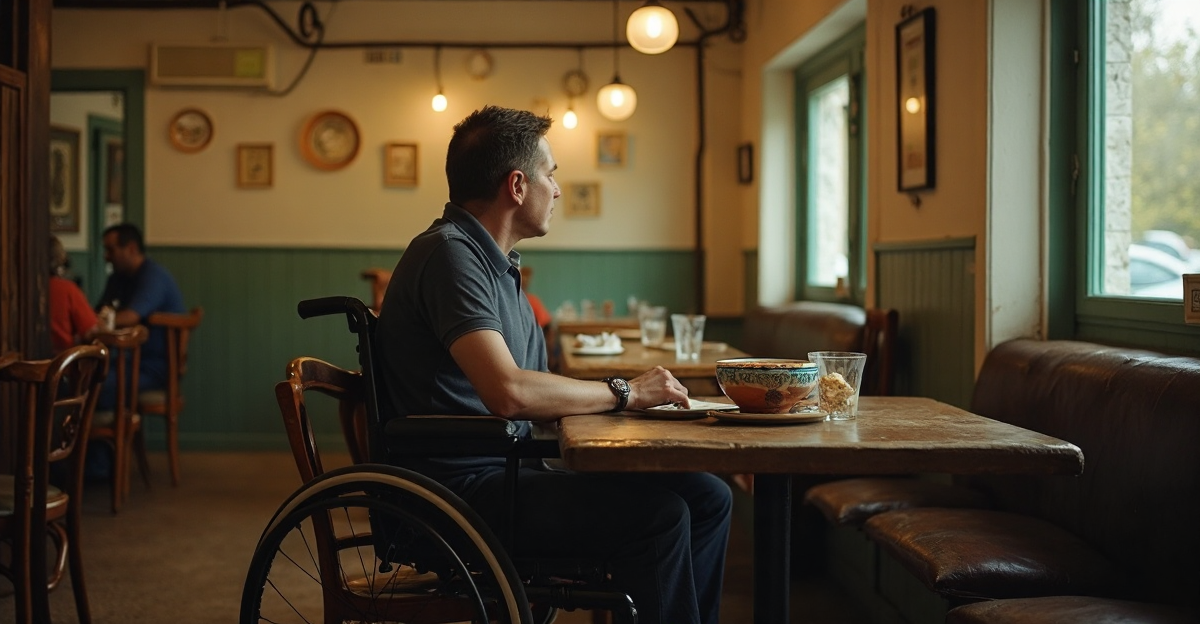
The two places a restaurant visit can fail for a wheelchair user are predictable, and neither one is the food. One is the threshold — the step at the door, the door that is too narrow, the ramp that is really a slope you have to push against. The other is the table itself: too high, too close to the wall, or a seat with no room for the wheels to come under. Both are things you can settle before you set off, if you know what to ask.
Most of the checking is short. Two or three questions, answered by phone or message, and the evening is either planned or not. This is a walkthrough of the questions, in the order that saves the most time.
The two failure points, and why the table is the one to check
The entrance is the easier one. Step-free access at the front door is the thing buildings are inspected for, it is the thing people photograph, and it is the thing most access data captures when it captures anything. If a venue gets the door right, you can usually get in.
The table is the one that gets forgotten. A venue can be fully step-free from curb to counter and still hand you a table with no knee space — high enough that the seat sits off the floor, or close enough to the wall that the wheels can't come in at all. The chair goes under; the wheels do not. And you only find out when you are already sitting down, the order is placed, and the meal is a performance.
This is why the pre-visit call exists. The entrance question is a yes/no question the front of house can answer in ten seconds. The table question — can the wheelchair get under the table, and which seating would you suggest for that? — is the one that tells you whether the kitchen actually thinks about the room. A place that fumbles the second question may still be a good place to eat; it just means you should be the one choosing the table, not the one hoping.
The three questions to ask, and what each answer means
Ask them in this order, because the first one filters out most of the risk fastest.
1. Is the entrance step-free, and is the path to it clear? This includes the sidewalk and the approach, not just the door — and the step that is inside the door, not just the one outside. A step-free door with a dropped curb on the far side of the street is not step-free. A step-free door with the accessible entrance round the back is step-free in principle and a walk in practice. If the answer is "it depends on the day," ask which day it is.
2. How wide is the door you would actually use? Comfortable wheelchairs are roughly 60–70 cm wide, so a door needs more clear width than that — and the common rule of thumb for comfortable passage is roughly 80–90 cm clear. A restaurant with a 70 cm front door and a 100 cm back door may be fine — if you use the back door. If they can't tell you, they probably haven't measured, and the check is worth asking anyway. Door width is the one number in this whole post that is hard to fake, and it is the one most likely to be missing from any online access data.
3. Can the wheelchair get under the table, and which seats would you suggest? This is the question that separates a venue that has hosted wheelchair users from one that has not. A venue that has hosted them can tell you which corner of the room works, which table is lower, and which chair pulls out farthest. A venue that hasn't will look at you and ask what you mean. Both answers are useful. The first one gets you a good meal. The second one gets you a plan for choosing your own seat, or a fallback list that you are glad you kept.
The toilet is the part everyone forgets
The toilet is not where the meal happens. It is where the meal ends, or where the evening turns into a problem you didn't sign up for. An accessible toilet is a real thing — turning space, grab rails, a lower basin — and most restaurants in most cities do not have one. Where they do, it is usually marked, usually at the back, and usually locked with a key that the front of house does not always know how to find.
Ask about it. "Do you have an accessible toilet, and do you have the key?" is a reasonable question in a restaurant. The first part gets a yes or a no. The second part gets you the answer you actually need, because a locked accessible toilet is not an accessible toilet.
If the answer is no, that is information. It does not make the restaurant unusable, but it changes the plan: pick a venue near an accessible public toilet, or near another restaurant that has one, and keep the map of it in your head for the evening.
What to check in advance — and what online data won't tell you
The good news: most of this is a phone call or a two-line message. The bad news: the online data that claims to answer it is only as good as the last person who checked. Access details on maps and directories come from a mix of self-reporting, staff memory and crowd-sourced corrections. In dense cities with many visitors, the data is often useful and reasonably fresh. In smaller towns, in older buildings, and in venues that have not changed hands in decades, it is frequently missing or wrong — the ramp that was removed, the entrance that moved, the toilet that was locked for the renovation and never reopened.
Treat any online "wheelchair accessible" label the way you would treat any unverified claim: as a shortlist, not a guarantee. The two-minute call settles the rest. If you have a map app with an accessibility filter — the one built into your phone's maps, or one like NearEats that carries wheelchair-access details for many venues — it is worth using as the starting point, but it is not the end of the check. The label is the beginning of the conversation, not the answer.
What to do when the answer is no
A no, said early, costs an afternoon of research. A no, discovered at the counter, costs the evening. The first kind of no is the one you want — the one that arrives by phone, about the toilet, about the table, about the door that turns out to be 70 cm and not 90. It is disappointing for about thirty seconds, and then it is a gift: you now know which venues to keep on the fallback list and which to stop checking.
A few habits make the nos cheaper. Keep a fallback list of two or three venues you have already checked and been answered yes by, and keep the answers in your notes so you don't have to re-ask. When a venue gives a no on the table but a yes on everything else, ask about the terrace or the back entrance before you write it off — sometimes the "accessible" answer is the one that requires a second question. And if the venue you want is the one that can't answer, that is a decision you get to make before you go, not one you make in a parking bay at 21:40.
If the group includes someone who uses a wheelchair, the planning burden belongs to the group, not to them. The two-minute call is one person's job for the evening. Assigning it early, and assigning it to the person who is least likely to feel pressured into taking it on their own, is the whole social half of the method. The same discipline — settle the question before the plate, keep a fallback list, and treat a no as information — is how the post on eating out with a severe food allergy starts too; the stakes differ, the method doesn't.
The short version
- The entrance is the easy check; the table is the one that gets forgotten. Ask about both, in that order.
- Door width is the one number worth looking up in advance — roughly 80–90 cm clear is the comfortable range.
- The toilet question ("do you have an accessible toilet, and the key?") is the one people skip and the one that decides the evening.
- Online "wheelchair accessible" labels are a shortlist, not a guarantee. The two-minute call settles the rest.
- A no, said early, is the good kind of no. Keep a fallback list of venues you have already checked, and ask about the terrace or back entrance before you write a venue off.
- If the group includes a wheelchair user, the planning call is one person's job. Assign it early.
Common questions
What is the single most useful question to ask a restaurant before you go?
Ask whether the entrance is step-free end to end — door, path and the first step inside if there is one — and whether you can reach the table itself. If they answer the first and ignore the second, that tells you something: the second is the one that decides whether the meal works. A place that can only tell you about the door usually hasn't thought about the room.
If a place says it is wheelchair accessible, can I trust it?
Treat it as a starting point, not a guarantee. Access labels come from self-reporting, staff memory and data mappers, and they are often missing or out of date — especially in smaller and older buildings. The label narrows your search; the two-minute phone call or message is what settles it. And if a place says yes and then fumbles, believe the fumble.
Why does the gap under the table matter more than the door?
Doors get fixed; tables get forgotten. A 90 cm door is a known quantity that buildings are built around, but table height, knee space and wall clearance vary from place to place — a high table, a deep apron or a tight corner can close the meal even when the entrance is fully step-free. If the front of house can answer the door question but not the table one, plan your seating choice around that.
What should I do when the answer to any of these is no?
Take it at face value and move on — a no about the toilet or the table is not a negotiation. Keep a fallback list of venues you have already checked, and consider whether the venue you are giving up on has a terrace or a back entrance worth asking about. A no, said early, costs an afternoon of research. A no, discovered at the counter, costs the evening.
Drafted with AI, then reviewed and edited by Robert Jensen before publishing.
Know where to eat before you start walking
NearEats shows the restaurants, cafes and bars around you — with what's open right now, diet options, step-free access and real walking time. One-time $1.99, no subscription.

Keep reading
Eating gluten-free abroad: what to check before you sit down
Gluten-free travel fails less often than you'd expect. The places that fail you are usually predictable — here is how to spot them before the food arrives.
Eating out with a severe food allergy abroad: what to check
A severe food allergy in a city you don't know is not a menu-reading problem. It is a kitchen-questions problem — and most of it can be settled before you sit down.